



In this guide
Self-managed super funds (SMSFs) are well known for their flexibility when it comes to retirement planning and investing, but when it comes to paying pensions to fund members, there are obligations that must be met from year to year.
If your SMSF has members using transition to retirement pensions, in retirement phase, or planning to retire soon, it’s important to review the fund’s retirement income needs and strategy. This includes ensuring the required minimum pension payments from any account-based pensions are in place.
What is an account-based pension?
Most super pensions these days are account-based pensions, so called because the pension is paid from a super account held in your name. These pensions were previously known as allocated pensions.
For SMSFs with account-based pensions, the amount supporting the pension must be allocated to a separate account for each member.
However, some government defined benefit super schemes, lifetime pension products offered by super funds, and annuities paid by life insurance companies offer non-account-based pensions where your fund will pay you a regular income over a set period, usually guaranteed for life or a fixed term. Unlike account-based pensions, these income streams do not have an identifiable account balance in the member’s name. These pensions must make payments at least annually.
Manage your SMSF smarter – for free

Access practical, independent guides and checklists to help you run your fund with confidence with a free SuperGuide account.
Find out moreMinimum pension payment rates
When you have an account-based pension, you are required to withdraw at least the minimum annual pension amount. The minimum is initially calculated on the start date of the pension using the opening balance and your age at the time. It is then recalculated on 1 July each year.
In the financial year you open your pension, the minimum payment is pro-rated to reflect the number of days remaining in that year.
Retirement phase account-based pensions have no maximum annual withdrawal.
Transition to retirement (TTR) pensions are not in the retirement phase. The minimum annual withdrawal for a TTR pension is the same as for a retirement phase pension but an annual maximum of 10% also applies. When you turn 65 or retire, your transition to retirement pension converts into a retirement phase pension with no maximum withdrawal.
To calculate the annual minimum pension amount, your pension balance is multiplied by a percentage factor that increases as you age. The table below shows the minimum pension percentage factor for each age group.
| Age of beneficiary | Pension percentage factor |
|---|---|
| Under 65 | 4% |
| 65 to 74 | 5% |
| 75 to 79 | 6% |
| 80 to 84 | 7% |
| 85 to 89 | 9% |
| 90 to 94 | 11% |
| 95 or more | 14% |
Payments must be received at least annually between 1 July and 30 June each financial year, although many people opt to receive monthly or quarterly payments.
The minimum annual payment amount is rounded to the nearest ten whole dollars. If the amount ends in an exact five dollars, it is rounded up to the next whole ten dollars.
Calculating the first payment
If you start an account-based super pension after 1 July, the minimum amount for the first year is calculated on a pro-rata basis according to the number of days remaining in the financial year, including the start day (see example below).
If your super pension commences on or after 1 June, no payment is required in that first financial year.
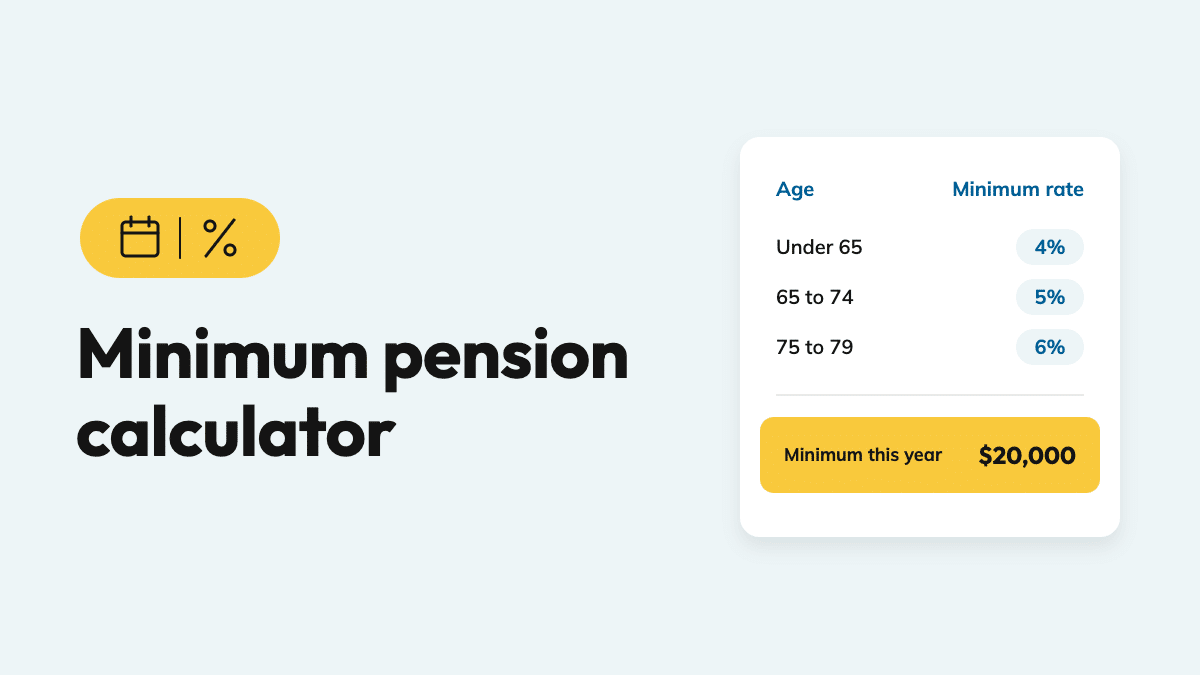
Minimum pension drawdown calculator
Work out your minimum pension payment for a full year, or for the first year of a new pension. Available to SuperGuide members.
Pension planning tips and strategies
The minimum pension percentage factor increases with the age of the recipient, so you are required to withdraw a higher percentage of your pension balance as you age.
It is also worth noting that most SMSF trust deeds and pension documentation allow you to change the amount of your pension payments during the financial year, provided you meet at least the minimum annual withdrawal requirements.
What if I don’t withdraw the minimum pension amount?
Minimum pension withdrawals are mandated by the government. If you fail to comply, your super pension could lose its tax-free status.
If you have an SMSF paying more than one pension, all pensions need to meet the minimum payment requirements independently from each other.
Where the minimum pension amount is not met, the following outcomes will arise:
- The pension would cease at the start of the relevant pension year, so 1 July, for the purposes of determining the fund’s exempt current pension income (ECPI). This would result in all of the fund’s earnings on the assets supporting the pension being taxed at the fund rate for the full year.
- As the pension ceased on 1 July, for tax purposes, any payments that had been made during the year would need to be treated as lump sum payments.
- The pension would cease at the end of the relevant pension year, so 30 June, for transfer balance account reporting (TBAR). Therefore, the deemed balance of the pension at 30 June would be used to determine the effect on your transfer balance account.
If the SMSF member then wants their account back in retirement phase in the next or a later financial year, they will need to ensure that all things necessary are carried out for a new pension to be commenced.
As you can see, the outcomes from failing the minimum pension rules are severe, so SMSF trustees need to be vigilant and arrange for at least the minimum pension payment to be made each year.
Does the minimum drawdown affect my Age Pension?
The amount of Age Pension you receive is determined by the income test and assets test.
The income test is not usually affected directly by the amount you withdraw from your super pension, as Centrelink applies the deeming rules to estimate your super pension income based on your balance.
The exception to this rule is if you have continuously held your super pension and received Age Pension or another Centrelink income support payment since 1 January 2015. In this case, Centrelink uses the actual income you withdraw from your super pension less a deductible amount in the income test, so the level of income you choose to withdraw can affect your Age Pension.
The assets test includes your total super balance and assets outside super. Withdrawing more from your super pension (and spending it) reduces the value of your balance, and therefore your assets, and could increase your Age Pension if you are most affected by the assets test.
Similarly, if your super pension generates deemed income in the income test, a lower pension balance will lead to smaller deemed income and could increase your Age Pension if you are most affected by the income test.
Why does the government set a minimum payment?
The reason for setting minimum annual payments is to satisfy the sole purpose test. That is, that super (and the generous tax concessions it receives) is designed to provide retirement income and for your balances to eventually run out. It’s not designed as a tax-effective way to transfer wealth to the next generation.
The percentage factor – normally beginning at 4% and rising to 14% as you age – is generally considered a safe amount for retirees to withdraw annually while maintaining an account balance that will keep the income flowing through retirement. As it’s impossible to know how long any individual will live, these amounts are based on the average lifespan for Australians who reach age 65, 75, 80, 85, 90 and 95.
Your super income stream will stop:
- When there’s no money left in the account
- If the minimum annual payment is not made
- If it is commuted (converted) into a lump sum
- When you die, unless you have nominated a reversionary pensioner who is entitled to continue to receive the income stream.
There is no maximum annual drawdown other than the balance of your account, unless it is a transition to retirement (TTR) pension. In that case, the maximum annual withdrawal amount is 10% of your pension account balance.
The bottom line
It is essential that SMSF trustees plan ahead to ensure they can meet any pension payment obligations. Failing to do so can result in costly and unexpected tax outcomes.
It will also create additional administrative and accounting tasks, resulting in an increase in the time and expense of running your SMSF.


Leave a Reply
You must be logged in to post a comment.