



In this guide
In the run-up to retirement, putting some extra money into your super can be a sensible idea. The same goes if you’re lucky enough to receive an inheritance or sell a large asset.
Not only will it give your retirement savings a boost, but when you withdraw super in retirement phase the income is generally tax free.
However, the contribution caps (or limits) can make it tricky to get a large amount of after-tax money into your super account in a single year. One solution is to use a bring-forward arrangement.
What is a bring-forward arrangement?
Although it sounds complicated, bring-forward contributions are just what they sound like. You can automatically bring forward your non-concessional contributions caps (or limits) from future years to contribute more than the non-concessional cap during a financial year without generating excessive contributions and paying additional tax.
Bring-forward arrangements are different from carry-forward contributions, which involve using previously unused concessional (before-tax) contributions cap amounts on a rolling five-year basis. Bring-forward arrangements, on the other hand, involve non-concessional contributions.
The annual non-concessional (after-tax) contributions cap is $130,000 in 2026–27.
A bring-forward arrangement is triggered automatically if you are eligible and you contribute more than the annual non-concessional cap in a single financial year. Once you trigger a bring-forward arrangement, you have a bring-forward period, which usually lasts three financial years including the year you triggered the arrangement.
When the rule is triggered, your bring-forward amount is set. This is three times the annual cap for a three-year arrangement. If you do not contribute more than your bring-forward amount during your bring-forward period, you will not generate excessive contributions and will not need to pay additional tax.
For example, you could contribute three times the cap in the first year and make no further contributions in the second and third year. Alternatively, you could contribute one and a half times the cap in the first year and spread the remaining amount over the two following years.
If your total superannuation balance was $2.1 million or more on the previous 30 June, your non-concessional cap is zero and you cannot use the bring-forward rule.
Where are you on the road to retirement?

Retirement planning isn’t the same for everyone.
Take our 2-minute quiz to find out which stage you’re at and what you could focus on next.
Who is eligible to use a bring-forward arrangement?
If you want to use the bring-forward rules, you need to check you meet all of the three eligibility criteria before you make your contribution:
Eligibility criteria 1: Age
If you are under 75 years of age at any time in the financial year you may be able to make non-concessional contributions of up to three times the annual general non-concessional cap in that financial year. You must be under age 75 for at least one day during the triggering year (the first year) and not already be in an active bring-forward period. When you turn 75, you legally have up to 28 days after the end of the month in which you turn 75 to make your contribution, although some super funds apply stricter time limits.
You don’t need to be working to make non-concessional contributions and use the bring-forward rule, regardless of your age. That means it is available to everyone under 75, including retirees.
Eligibility criteria 2: Total superannuation balance (TSB)
To make any non-concessional contribution (that is not an excessive contribution), your total superannuation balance (TSB) on the previous 30 June must be less than the general transfer balance cap for the year you’re contributing in. The general transfer balance cap for 2026–27 is $2.1 million.
Your total super balance (TSB) affects your eligibility to use the bring-forward rule and the length of your bring-forward period, as shown in the table below.
How much you can contribute under the bring-forward rule in 2026–27
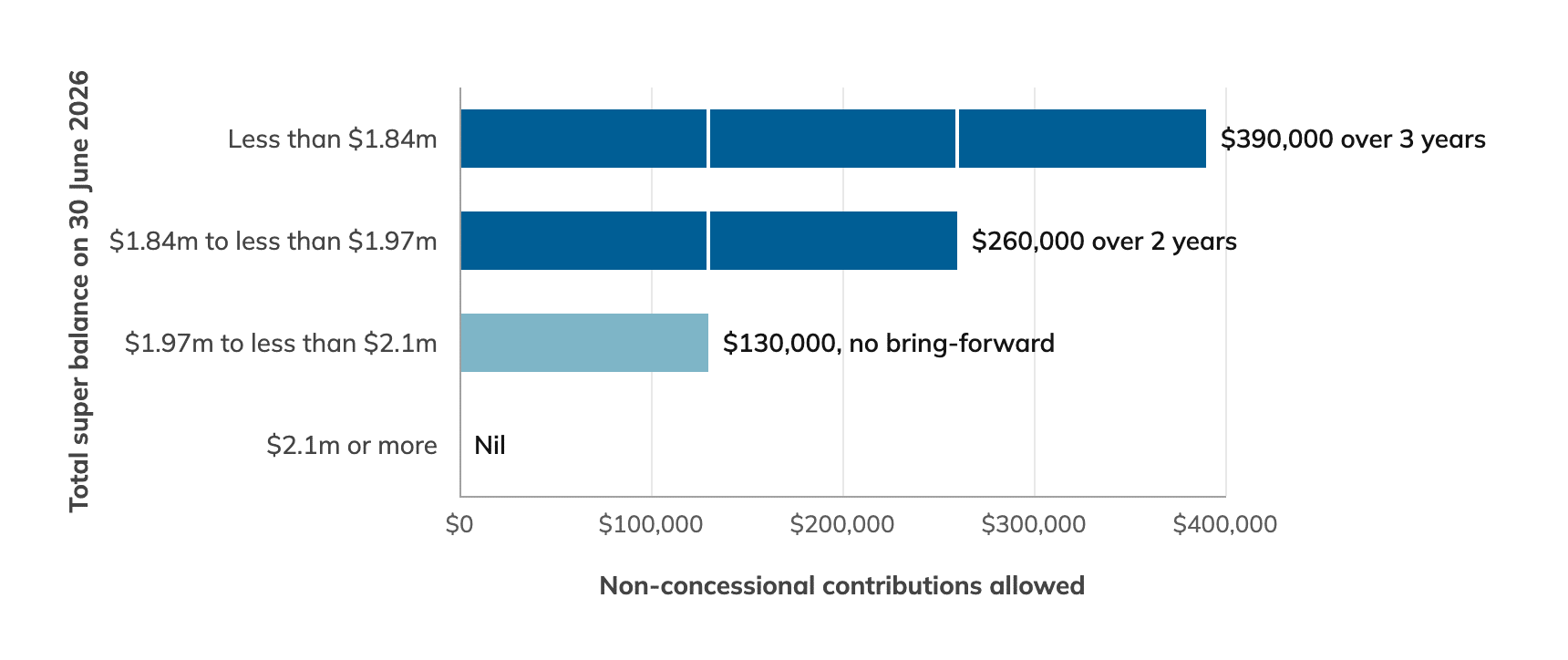
Assumes you are under 75 and not already in an active bring-forward period. Based on the 2026–27 non-concessional contributions cap of $130,000 and general transfer balance cap of $2.1 million.
Source: ATO
Available bring-forward amounts for arrangements triggered in 2026–27
| Your total superannuation balance on 30 June 2026 | Your available contribution amount and bring-forward period |
|---|---|
| Less than $1.84m | 3 years of caps ($130,000 x 3 = $390,000) 3 years bring-forward period |
| $1.84m to less than $1.97m | 2 years of caps ($130,000 x 2 = $260,000) 2 years bring-forward period |
| $1.97m to less than $2.1m | 1 year of cap ($130,000 x 1 = $130,000) No bring-forward, general non-concessional contributions cap applies |
| $2.1 million or more | Nil |
Different TSB thresholds and limits apply to bring-forward periods that were triggered in an earlier year.
To make any non-concessional contribution (that is not an excessive contribution), your TSB on the previous 30 June must be less than the general transfer balance cap for the year you’re contributing in. This rule means the remaining cap for the second or third year of a bring-forward arrangement is reduced to nil for any financial year when your TSB is greater than or equal to the limit on the prior 30 June. In 2026–27 the general transfer balance cap is $2.1 million.
For example, if your total super balance was $1.83 million on 30 June 2026 and you trigger a bring-forward arrangement in 2026–27 you will start a three-year arrangement. However, if your total super balance on 30 June 2027 is higher than $2.1 million, you will have a non-concessional cap of zero for the 2027–28 year (assuming the transfer balance cap has not increased). In this case, you will not be able to make non-concessional contributions without exceeding the contribution cap in the second year of your bring-forward arrangement. Whether contributions are permitted in the third year will depend on your total super balance on 30 June 2028 and the transfer balance cap for 2028–29.
Eligibility criteria 3: Triggering a bring-forward arrangement
If you want to commence a bring-forward arrangement in a particular financial year, you must not have already triggered a bring-forward arrangement in a previous year and be in what the ATO terms an ‘active bring-forward period’.
You are automatically considered to be in an active bring-forward period if you contribute more than the annual general non-concessional contributions cap in a single financial year ($130,000 in 2026–27).
It’s possible to accidentally trigger a bring-forward arrangement without realising it. Before making personal contributions into your super account, consider all the contributions you have made to all your super funds, as excess concessional (before-tax) contributions you have not withdrawn from super are also counted towards your non-concessional contributions cap.
Case study 2
Carl would like to boost his retirement savings in the years before his planned retirement at 61.
Carl decides to sell an investment property he owns and then makes a non-concessional contribution into his super account of $280,000 from the proceeds during October 2026. His total super balance on 30 June 2026 was $1.2 million, so he has access to a three-year bring-forward arrangement.
As Carl exceeds the annual general non-concessional contributions cap of $130,000 applying in 2026–27, he automatically triggers the bring-forward rule when he makes this large contribution. Carl can make further non-concessional contributions of up to $110,000 during his bring-forward period (made up of the 2026–27, 2027–28, and 2028–29 financial years) without creating excessive contributions.
On 1 July 2029, Carl’s non-concessional contributions cap will reset and, if he meets all the eligibility criteria, he can then make further non-concessional contributions up to the annual contributions cap applying at that time or start another bring-forward arrangement by contributing more than the annual cap in one financial year.
Carl’s bring-forward period

Illustrative example based on the 2026–27 non-concessional contributions cap of $130,000.
Source: SuperGuide calculations
How do I start a bring-forward arrangement?
Starting a bring-forward arrangement is easy.
You don’t need to notify your super fund or the ATO, or even fill in an application, as your super fund automatically reports all your contributions to the ATO.
If you are eligible to make non-concessional contributions and you contribute more than the annual general cap in one financial year ($130,000 in 2026–27), you automatically gain access to your future years of contributions caps. This is referred to as triggering the bring-forward rules.
Common questions about the bring-forward rule
The bring-forward rule can be confusing, so we’ve addressed some common questions. Many of these questions come from our quarterly member Q&A webinars.
Q: I understand the bring-forward strategy, which allows up to $330,000 or three years after tax contributions (3 times $110,000) to be made in a single year, or alternatively, various amounts up to $330,000 over a three-year period. If you take this up but contribute, say, only $300,000, so $30,000 short in the three years, then in year four, are you able to contribute after tax of $110,000 plus the $30,000 shortfall from years one to three?
A: The contribution rules are anything but easy, especially when you look at the rules around the carry-forward or the bring-forward rules. It’s not easy but the way I like to explain it is, essentially, in the very first year where you make a non-concessional contribution above the annual limit, so in this case, above $110,000, as soon as that contribution goes above $110,000 for the year, you trigger, you automatically enter the three year bring-forward period.
So, as soon as our contributions in year one or in the first year you go above $110,000, that becomes the first year of the three year bring-forward rule, which means that year and the next two financial years, we can put in a total of $330,000.
Now, at the end of that third year, it resets. So, if you haven’t used up all of that $330,000, you lose it. So, use it or lose it, essentially, over that three-year period. So, it would then restart in that next period where you would have the $110,000. Or again, you could trigger the bring-forward rule to make that $330,000 contribution under the bring forward rule. So, it’s essentially a use it or lose it over those three years.
Now, we’ve also got some pretty good articles and guides on the website. I’ve just given you there three or four articles which cover the non-concessional contribution rules. Particularly, there was one released in July this year which is a guide to the bring-forward rule. Probably a good source of information if you’re looking for more on that.
Q: I’m a self-funded retiree and about to turn 60. I would like to make a $390,000 contribution to my accumulation super, $30,000 concessional plus $360,000 non-concessional using the bring-forward rule. Can I immediately, after making these contributions, transfer my accumulation super to a pension account, or do I need to wait three years due to the bring-forward?
A: There’s a few little issues that we need to look at here. The 30 second answer is no, you don’t need to wait your three years. If you’ve met a condition of release which allows you access to your money, you could start a pension if you meet those conditions of release. But there are, of course, some other bigger issues that we need to keep in mind.
I suppose the first one is when you’re making non-concessional contributions, or when you’re looking to access that three-year bring forward rule, which allows you to put in a larger amount, you need to make sure that you do check your total super balance, exactly what we just went through before. Remember that your total super balance on 30th of June last year, so 30th of June 2024, last financial year, affects our ability to make non-concessional contributions or how much of our non-concessional cap we can use up. The annual $120,000 non-concessional cap applies unless we use the bring forward rule, which allows us to contribute up to $360,000 in any one year, or combination of years over a three-year period. It allows us to make larger contributions, for instance, if we’re looking to retire and start pensions, or we’re younger and we come into other amounts of money.
There are also age restrictions on making non-concessional contributions. We can do it anytime up until age 74, so not yet 75. The non-concessional bring forward rules can also be made up to age 74, not yet 75. Check your total super balance on 30th of June 2024. If it was above $1.9 million, then your non-concessional cap this year in the 2025 year is zero. If you’re not below that general transfer balance cap, if your TSB is not below that $1.9 million, then your non-concessional cap is zero. Any amount you make this, you will be excess. If it was between $1.66 and $1.9 million, I’ll show you that shortly, then you may have reduced access to that three-year bring forward rule.
You mentioned, can you do this now? Of course, you need to check all of those things, your TSB, to make sure you fall within those levels. Also just think about whether you may have triggered the three-year bring forward rule last year or the year before, or even, say, 2022 or 2023. Are you still within that three-year period? If so, think about how that might affect you.
For those looking to make larger non-concessional contributions under the three-year rule, this is quite an important slide. The left hand side looks at what your total super balance was on 30th June last year, and then how much you can use under the non-concessional contribution cap rules this year. For instance, as I mentioned before, if your total balance is above $1.9 million, then your non-concessional cap this year is zero. Any amount will be excess. If your total super balance was below $1.66 million on 30th June 2024, then you could use the full three-year bring forward all that $360,000 to be contributed. Please do keep these in mind, especially if you do fall between those two brackets, because it may restrict how much you can contribute using the non-concessional contributions.
To get to the specific question, the money is in there, we’re assuming it’s all been done in a compliant way, you then do not need to wait for that three-year bring forward rule to end before you start a pension. The contribution has been made, it’s been allocated to your account, it’s a member benefit. In order, of course, to start the pension, you do need to meet a condition of release that allows you to access your super benefits.
Now, when I look at the question that has been posed, you’re probably falling into that bottom blue box there, which is retirement after age 60. If you do cease an arrangement under which you’re gainfully employed, and that happens after you turn 60, then all your money at that time becomes unrestricted, not reserved. You can start a pension. What we’ve looked at here is the ability to make the contribution, once it’s been accepted, if you meet a condition of release, that we’re looking at on this slide, you can then start a pension. You don’t need to wait for that three-year period to come to an end.
When it comes to non-concessional contributions, there are some tricky things to be aware of, as I mentioned, with those brackets on balances. Jump on and have a look at the non-concessional super contributions guide. It takes you through all that, and it might just be a handy reference tool for you if you’re looking to make a larger non-concessional contribution amount. It’s something certainly worth looking at.
If you’re someone now looking to then access your money after you’ve made those contributions, have a look at the recently updated article around accessing super. This covers all the conditions of release. It sets out all the conditions that need to be met when you want to access some money from super, ranging from retirement through to permanent incapacity. Another great article by Barbara there. Have a look at that around accessing superannuation benefits.
Get more guides like this with a free account
better super and retirement decisions.



Leave a Reply
You must be logged in to post a comment.