


Division 293 tax is an extra 15% on some or all of your concessional contributions when your income plus those contributions is more than $250,000 in a financial year.
Use this calculator to estimate whether it applies to you in 2026–27, and how much extra tax you could pay.
How to use the calculator
- Enter your salary before tax. Don’t include your employer’s super contributions, as the calculator works out your 12% super guarantee.
- Enter any reportable fringe benefits, other taxable income and tax deductions for the year. Self-employment income goes in other taxable income.
- Enter any salary sacrifice, personal contributions you will claim a tax deduction for, and employer contributions above the super guarantee.
- If you can use the carry-forward rule, enter the unused concessional cap you have available.
- Check the help notes below the calculator if you’re unsure which figures to use.
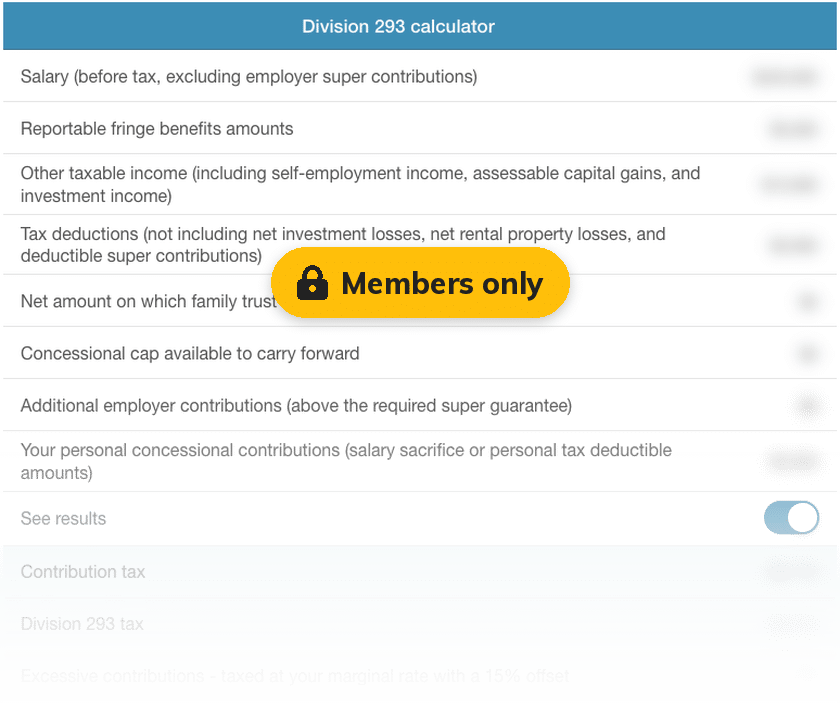
Your income for Division 293 purposes includes your taxable income, any reportable fringe benefits, any net investment losses (including net rental property losses) and any amount on which family trust distribution tax has been paid.
That’s why the tax deductions you enter shouldn’t include net investment or rental property losses. They are added back for Division 293 purposes.
Salary sacrifice and personal contributions you claim a tax deduction for are counted as contributions, not income, so they aren’t counted twice.
A one-off amount, such as a capital gain or a large bonus, can take you over the threshold for that year only.
Concessional contributions count, including your employer’s contributions, salary sacrifice and personal contributions you claim a tax deduction for.
Contributions above your concessional cap ($32,500 in 2026–27, plus any unused amounts you can carry forward) don’t count. They are taxed at your marginal tax rate instead.
If your total super balance was under $500,000 on the previous 30 June, you can use unused concessional cap amounts from up to five previous financial years. Contributions made with these amounts count towards Division 293 tax.
You can find your unused amounts in ATO online services through myGov. Select Super, then Information, then Carry forward concessional contributions.
Division 293 tax is 15% of the lower of your concessional contributions or the amount by which your income plus contributions is more than $250,000.
The $250,000 threshold is not indexed. It has applied since 1 July 2017.
- Your employer pays 12% super guarantee on your salary, up to a maximum of $32,500 in the financial year.
- All contributions for salary earned this financial year reach your super fund before 30 June.
- No contributions for salary earned in a previous financial year are added to your super account this financial year.
- You are not contributing to a constitutionally protected (untaxed) super fund.
If you are a member of a defined benefit fund, Division 293 tax on those contributions is recorded as a debt and generally paid when your benefit is paid to you. Interest is added to the debt.
The ATO works out any Division 293 tax after you lodge your tax return and sends you a notice of assessment.
You can pay it with your own money or elect to have it released from your super through myGov.
Get more guides like this with a free account
better super and retirement decisions.

Leave a Reply
You must be logged in to post a comment.