

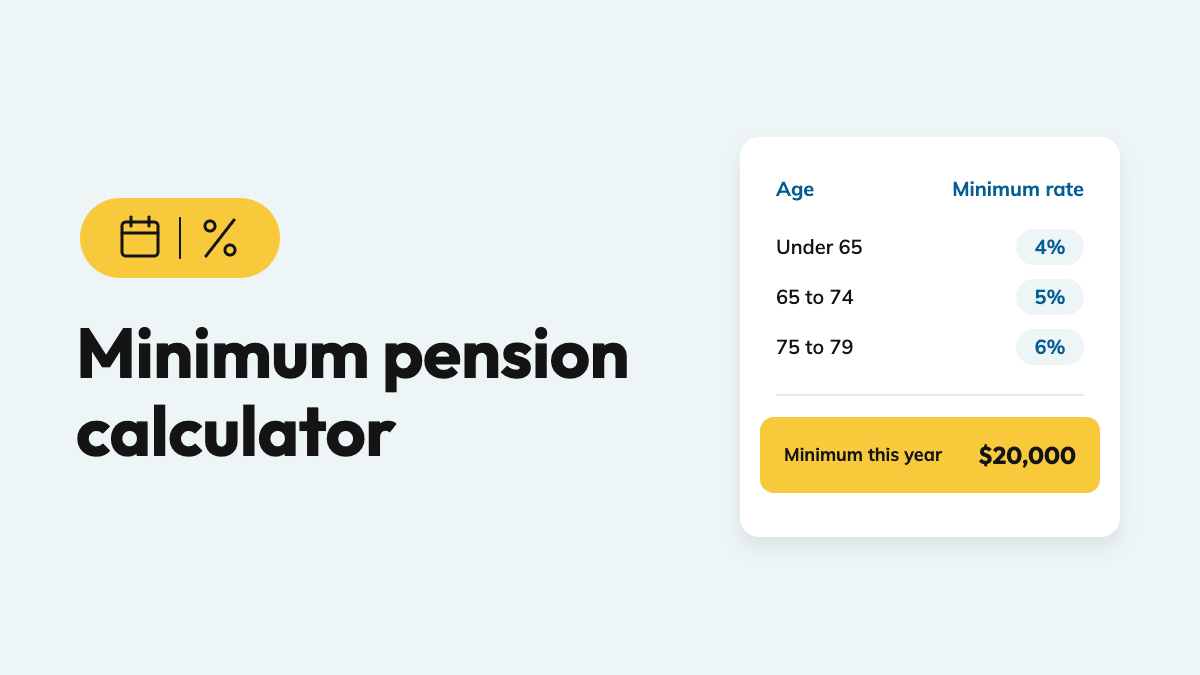
Use this calculator to work out the minimum you must withdraw from your account-based pension this financial year, or in the year your pension starts.
If you’re starting a transition to retirement pension, it also shows the maximum you can withdraw.
How to use the calculator
- For a full year, enter your age and pension balance on 1 July.
- For the first year of a new pension, enter your age and balance on the day the pension starts. The calculator works out the minimum for the days left until 30 June.
- Check the help notes beside the calculator if you’re unsure which date or age to use.

If your pension continued from the previous financial year, use your pension balance and your age on 1 July.
If your pension started this financial year, use your balance and your age on the day it started.
Your minimum doesn’t change if you have a birthday during the year.
In the year a pension starts, the minimum is pro-rated for the number of days from the start date to 30 June, including the start date.
If your pension starts on or after 1 June, no payment is required until the next financial year.
| Age of beneficiary | Percentage factor |
|---|---|
| Under 65 | 4% |
| 65 to 74 | 5% |
| 75 to 79 | 6% |
| 80 to 84 | 7% |
| 85 to 89 | 9% |
| 90 to 94 | 11% |
| 95 or more | 14% |
Source: SIS Act
The minimum is rounded to the nearest $10. An amount ending in exactly $5 is rounded up to the next $10.
A transition to retirement (TTR) pension has the same minimum as a retirement phase pension. While it is not in retirement phase, you also can’t withdraw more than 10% of the balance each year. The calculator shows this maximum when you choose a TTR pension.
If you have more than one account-based pension, a separate minimum applies to each one. Use the calculator once for each pension.

Leave a Reply
You must be logged in to post a comment.