


Use this calculator to see how a recontribution strategy could change the tax components of your super, and how much tax it could save the adult children or other non-dependants who inherit it.
It also shows your tax-free and taxable components after the recontribution, whether you add it to your existing account or hold it in a separate new account.
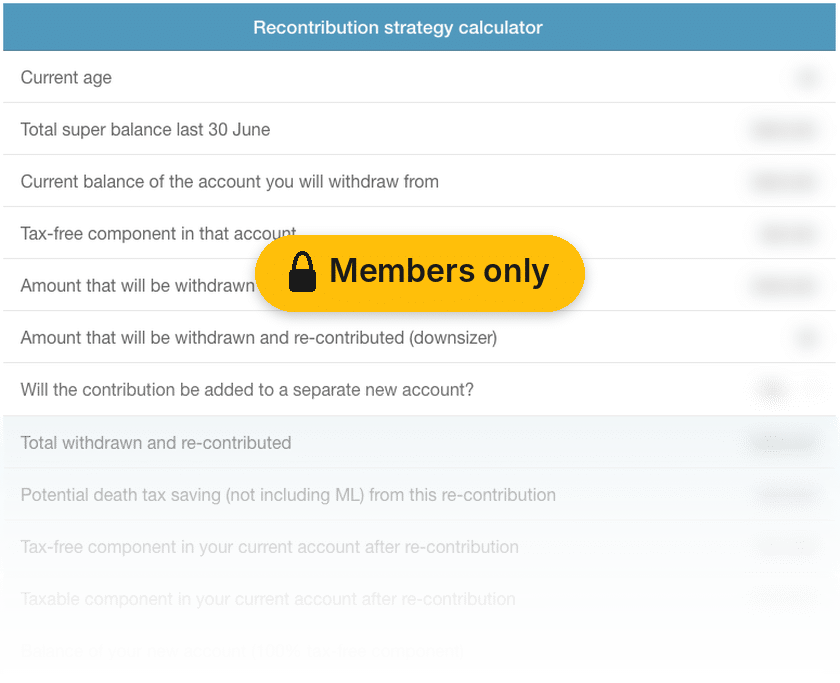
How to use the calculator
- Enter your age and your total super balance on the last 30 June. You can find your total super balance in myGov, through the ATO’s online services.
- Enter the current balance and tax-free component of the account you will withdraw from. Your super fund’s latest statement or online account shows both.
- Enter the amount you will withdraw and recontribute as a non-concessional contribution, a downsizer contribution, or both.
- Choose whether the recontribution goes into your existing account or a separate new account.
To withdraw a lump sum, you generally need to have turned 60 and retired, left a job after turning 60, or reached 65.
To recontribute, you generally need to be aged under 75 to make a non-concessional contribution. From 75, only a downsizer contribution is possible, and a downsizer contribution at any age needs the sale of an eligible home.
To make non-concessional contributions, your total super balance on the last 30 June must be below the transfer balance cap ($2.1 million in 2026–27). Lower thresholds apply to use the bring-forward rule.
- You are eligible to make a non-concessional or downsizer contribution of the amount you enter, and you are not in an active bring-forward period.
- The account you withdraw from is in a taxed super fund.
- You recontribute to your own super, not your partner’s.
- Your death benefit is paid into your estate before being distributed, so the potential tax saving does not include the Medicare levy.
Any withdrawal is made in the same proportions of tax-free and taxable component as the account’s balance on the day of the withdrawal. You can’t choose to withdraw only the taxable component.
For example, if your account is 80% taxable component, 80% of any withdrawal is taxable component. The amount you recontribute becomes tax-free component.
If you recontribute to your existing account, the new tax-free component is mixed with your taxable component, and future withdrawals take some of both.
Holding the recontribution in a separate new account keeps it 100% tax-free component. You can then withdraw from your original account without drawing down the tax-free component, and nominate different beneficiaries for each account.
An SMSF can’t hold two accumulation accounts for the same member, so SMSF members would need to hold the new account in another fund. In other funds, tell the administrator you are holding two accounts on purpose so they aren’t consolidated.
While your super is in the accumulation phase, future investment growth is added to the taxable component.
Starting a retirement phase pension freezes the proportions. A pension started with a balance that is 100% tax-free component stays 100% tax-free component.
Your spouse can inherit your super tax free. Adult children and other beneficiaries who are not tax dependants pay no tax on the tax-free component, but pay 15% on the taxable component (taxed element) and 30% on any untaxed element.
The Medicare levy is added to the tax on taxable components paid directly from a super fund, but not when the benefit is paid into your estate.
The calculator assumes you recontribute to your own super. Contributing to your spouse’s account instead can help a couple use both transfer balance caps, reduce Division 296 tax or, where one partner is younger, improve the older partner’s Age Pension. Our recontribution strategy guide explains how.
Get more guides like this with a free account
better super and retirement decisions.

Leave a Reply
You must be logged in to post a comment.