



In this guide
- How a recontribution strategy works
- Where are you on the road to retirement?
- Understanding your super benefits
- The proportioning rule
- When can a recontribution strategy help?
- Am I eligible to use a recontribution strategy?
- Important points to consider before using a recontribution strategy
- Common questions about the recontribution strategy
If you have heard a super recontribution strategy may be worth considering but wondered what it was, the name says it all – you withdraw some of the savings from your super account and then recontribute them back into the super system.
Which raises an obvious question. Why take money out of super and then put it straight back in again?
Like many things to do with super, it’s all about the tax benefits that could be gained from using this strategy.
How a recontribution strategy works
Implementing a recontribution strategy simply involves withdrawing a lump sum from your super account and then recontributing the money back into your, or your spouse’s, super account as a non-concessional (after-tax) contribution, downsizer contribution, or a mix of both.
To be eligible to make a lump sum withdrawal you generally need to have turned 60 and retired, left a job after your 60th birthday, or reached age 65. Withdrawals are tax-free when you are 60 or older, except if you are a member of an untaxed super fund.
Making a withdrawal followed by a non-concessional or downsizer contribution converts any taxable components you withdrew into a tax-free component. You may be asking why this matters if your withdrawals are already tax free, and the answer is that tax-free components are passed on without tax after you pass away, while taxable components attract at least 15% tax when paid to beneficiaries that are not tax dependants (including adult children).
Using your withdrawal to contribute to your spouse’s account could also help you keep your individual balances below the transfer balance cap or the $3 million limit above which your balance will begin to attract additional tax (Division 296).
For an example of how a recontribution strategy can be used, check out our detailed case studies on using the recontribution strategy to reduce death benefit tax, or recontributing a super death benefit.
Where are you on the road to retirement?

Retirement planning isn’t the same for everyone.
Take our 2-minute quiz to find out which stage you’re at and what you could focus on next.
Understanding your super benefits
When trying to get your head around how a recontribution strategy works, it’s important to realise that the money in your super account is classified into separate components:
1. Tax-free components
The tax-free component of your super is generally the contributions on which you have already paid tax (non-concessional contributions). Some older components including pre-July 1983 benefits were also converted into tax-free component when the current system was introduced in 2007.
The tax-free component is always released from super tax free, regardless of your age when you take your super benefit, or who you leave your benefits to when you die.
2. Taxable components
The taxable components are the concessional contributions (such as Super Guarantee and salary-sacrifice contributions) held in your super, plus all the accumulated investment returns on your savings. This is divided into:
- Taxable component – taxed element
- Taxable component – untaxed element (this only occurs in untaxed super funds such as SuperSA’s – TripleS scheme and West State Super).
Your taxable component is calculated as follows:
Total super account balance – tax-free component
= Taxable component
The proportioning rule
Whenever money is paid out of your super, the payment is made in the same proportions of tax-free and taxable component as your total balance.
For example, if your super account has an 80% taxable component and 20% tax-free component, any withdrawal will consist of 80% taxable component and 20% tax-free component. Withdrawals cannot be made from only one component of your account.
When you make your recontribution, you can consider keeping it in a separate account so that it is not mixed with taxable components. Keeping your components separate can be useful for two reasons:
- You can make future withdrawals from your original account without being forced to withdraw any of the tax-free component you have just created (you may then proceed to recontribute those additional funds to the account you’re using to hold tax-free components if you wish)
- You can choose who to nominate as the beneficiary of each account. Beneficiaries who would pay tax on taxable components of inherited super death benefits can be nominated to receive the account holding the tax-free component.
Importantly, future investment growth will be added to the taxable component when an account is held in the accumulation phase. Starting a retirement income stream (pension) will however freeze the taxable and tax-free proportions. For example, if a pension is started with a balance that is 100% tax-free, the pension will remain 100% tax-free component.
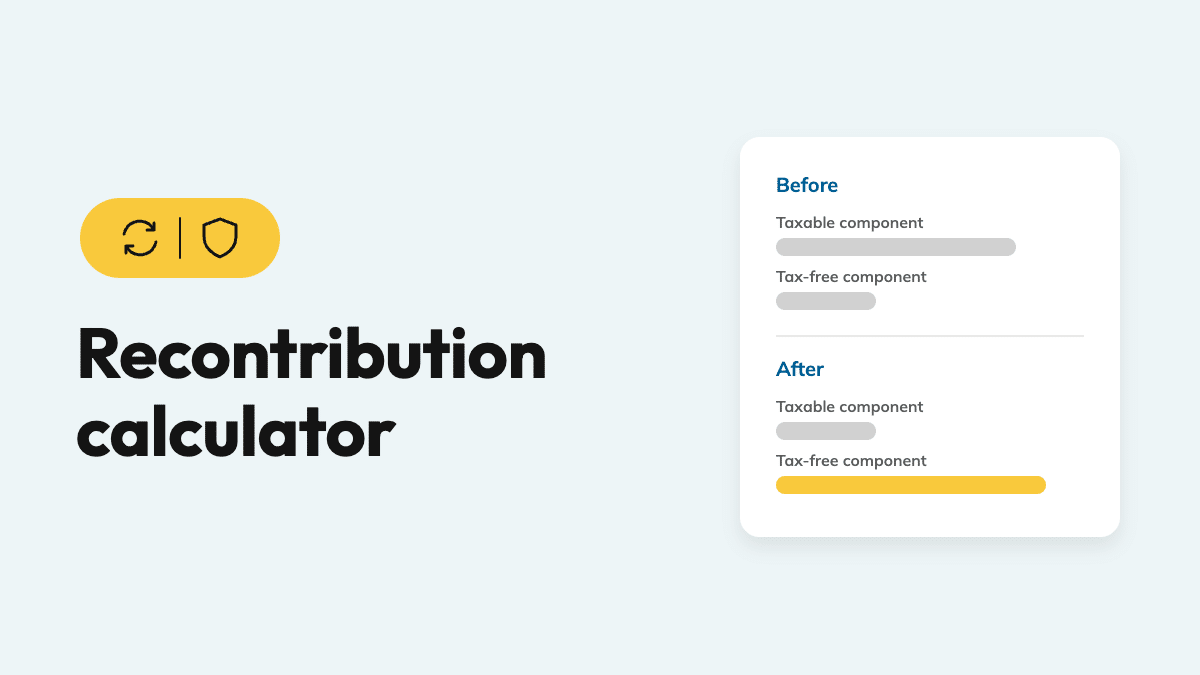
Recontribution strategy calculator
See how a recontribution could change the tax components of your super and cut the death benefit tax paid by adult children or other non-dependants. Available to SuperGuide members.
When can a recontribution strategy help?
There are four situations when a recontribution strategy can be particularly valuable:
1. Estate planning
For many people, super benefits are ultimately left to adult children or other relatives after both partners pass away. While your spouse can inherit your super (including taxable components) tax free, adult children and others generally can’t because they are not dependants according to tax law (tax dependants).
Using a recontribution strategy to increase the tax-free component and reduce the taxable component of your super benefit can cut – or even eliminate – the tax payable by your non-tax dependant beneficiaries, so they receive a larger benefit.
Beneficiaries who are not tax dependants pay no tax or Medicare levy on tax-free components, while the relevant tax rates are 15% for the taxable-taxed element, and 30% for any taxable-untaxed element. Medicare levy applies in addition to these rates for taxable components when benefits are paid directly to beneficiaries from a super fund but does not apply when the funds are paid into your estate to be distributed according to your will.
2. Utilising both spouses’ transfer balance caps
When you retire and start withdrawing your super, there is a limit to how much you can transfer from your accumulation account into a retirement phase pension account, where future investment earnings are tax free. This is called the transfer balance cap and is currently set at $2.1 million (in 2026–27).
If you have more than the cap in super and your spouse has less, withdrawing money from your account and recontributing it into your spouse’s will increase the amount you (together) can transfer into the tax-free retirement phase.
3. Reducing liability for Division 296 tax
Additional tax on the investment income your super account generates applies when your total super balance (TSB) is above $3 million.
If your balance is above the threshold or likely to reach it and your spouse’s balance is below it, withdrawing from your account to contribute for your spouse could reduce or eliminate your tax liability.
In 2026–27 Division 296 applies when your TSB is above $3 million on 30 June 2027. In future financial years, the higher of your TSB on the previous 30 June and year-end 30 June will be used to calculate your liability.
4. Moving super to a younger spouse to improve Age Pension
If you and your spouse are not the same age, holding super in the younger person’s name can improve the Age Pension rate paid to the older partner once they turn 67.
This occurs because superannuation invested in a super account in the accumulation phase is not assessed in Centrelink’s means tests until the account’s owner reaches Age Pension age (67).
Money withdrawn from the older partner’s super account can be re-contributed into the younger person’s super to prevent it being assessed.
Am I eligible to use a recontribution strategy?
To implement a recontribution strategy with your existing super benefits, you must be eligible to withdraw a lump sum from your super and you also need to be able to recontribute the money back into the super system. This usually means you:
- Are aged 60 to 74 so you are eligible to both withdraw from your super account and make contributions, or if you’re aged 75+ you are eligible to make a downsizer contribution
- Have retired or have met another condition of release to access your super benefit, such as leaving a job after turning 60, or turning 65.
- Had a total super balance below the transfer balance cap (currently $2.1 million) last 30 June, so you’re eligible to make non-concessional contributions in the current financial year. Note that lower balance thresholds apply to contribute more than the non-concessional cap using the bring forward rule. If your balance is too high, you may instead be able to contribute to your spouse’s super account.
Important points to consider before using a recontribution strategy
If a recontribution strategy sounds like it could help you achieve your retirement or estate planning goals, there are some important points to bear in mind before taking the leap:
- Any recontributions you make into your – or your spouse’s – super account are subject to the normal contribution rules and caps.
- If you are turning 75, the recontributed amount must be received by your super fund no later than 28 days after the end of the month in which you turn 75 (except for downsizer contributions).
- Check your total super balance (TSB) before using a recontribution strategy. You can access the details via myGov using the ATO linked service. Your TSB must be under the transfer balance cap ($2.1 million in 2026–27) on the most recent 30 June to be eligible to make any non-concessional contributions in the current financial year. If you are unable to make non-concessional contributions, you may be eligible to make a downsizer contribution or contribute to your spouse’s account instead. You may also consider withdrawing enough to bring your total super balance below the cap and make non-concessional contributions possible in the following financial year.
- You may have to pay transaction costs – such as a buy-sell spread or capital gains tax (CGT) – on any investments your super fund must sell to pay for your withdrawal and recontribution.
- You may need professional advice to implement this type of strategy, as it can be complex to calculate the most effective amount to withdraw and recontribute into your, or your spouse’s, super account. For example, you need to take into account contribution caps and the time you have available to recontribute before turning 75.
- If you have previously triggered a bring-forward arrangement that has not yet ended, you may not be able to recontribute the money back into your super without exceeding your personal non-concessional contributions cap.
Common questions about the recontribution strategy
The recontribution strategy raises plenty of questions, so we’ve answered some common ones from SuperGuide members below.
Q: I think I understand the recontribution strategy to lessen the effect of the taxable component on non-tax-dependents, eg, under an inheritance scenario for non-dependent adult children. BUT, if I am to draw from super (be it accumulation phase, or an account-based pension phase), and then re-contribute (as a non-concessional contribution), is that re-contribution subject to the 15% contributions tax? ie, how does the fund know that the funds I’m circulating have been passed through the super system at all? Is there a form I have to fill in with the fund for this to occur?
A: The amount you re-contribute is not subject to contributions tax because it is a non-concessional contribution.
Super funds assume all personal contributions from members are non-concessional unless they receive notice the member intends to claim a tax deduction for the amount.
If you do claim a tax deduction for contributions, they are converted to concessional amounts and contribution tax is deducted. Concessional contributions form a taxable component in your super rather than a tax-free component.
Q: I am 70 now and last year I rolled over all my super from NSW State Super (SASS) to ART super fund. Can you please let me know if that rollover is considered to be a recontribution so that all my benefit in the new fund is tax-free? Can you also tell me if my re-contributions must follow the requirements based on the non-concessional contribution cap (including the bring-forward rule) until I am 74, or would these be treated separately?
A: A rollover is a transfer, not a contribution, so your rollover from SASS to ART is not a re-contribution.
To use a re-contribution strategy, you would need to make a withdrawal from your ART account which would be paid into your bank.
You could then use the funds in your bank account to make a contribution.
All contributions are counted towards the contribution caps. There is no special treatment for money you withdrew from super and are re-contributing.
Q: We are both retired, over 65 and have a SABP in our SMSF. However, our pensions are comprised of 95.64% and 92.21% taxable component. What does that mean? It appears that we are not taxed in the super fund, so does that mean we are taxed on our income stream and if yes, how do we change the taxable component to a non-taxable component?
A: The taxable component of your super comes from pre-tax contributions (including employer amounts, salary sacrifice, and personal tax deductible contributions) and investment earnings. The tax-free component comes from after-tax personal contributions and certain other amounts that accumulated before 2007.
The tax-free component of your account is always paid out tax-free, no matter the recipient.
The taxable component is also tax-free when you withdraw it personally because you are over the age of 60.
Investment earnings are not taxable in the fund because your account is in the pension/retirement phase.
However, the taxable component does attract tax when it is paid to non-dependent beneficiaries according to the Income Tax Assessment Act (ITAA) after you pass away (this includes adult children).
A re-contribution strategy is a common way to reduce the taxable component and therefore the tax to beneficiaries.
Q: I am 71 and so is my wife and we are retired. I have a super and a pension account whereas my wife has only a super account.
I have just opened two new super accounts (one for me and one for my wife) and contributed a non-concessional 100K to each of them. However, I noticed they both show a “tax free” component of 100K and also a “taxable” component which is the small growth amount since.
I was puzzled if this is correct or I have done something wrong. I thought that all non-concessional contributions including their growth returns will be “tax free”. What could have contributed to this taxable component in the new super account?
Sign up free to read this answer
Access this answer with a free SuperGuide account. You’ll also get access to 100+ free guides.
Q: My question relates to how my wife and I are able to use the tax minimisation benefits of the recontribution strategy in relation to our daughter (aged 21, working full time and living at home with us) who will inherit our super after we both die.
My wife and I are each other’s reversionary beneficiaries. We both recently turned 60 and are now fully retired, and have converted all of our super from accumulation to pension accounts.
Because a high percentage of our super is taxable component, are we able to simply withdraw the maximum each using the bring forward rule from our pension accounts and put these amounts back into the same existing pension accounts as non-concessional contributions?
Our concern is that we may have needed to do this while still in the accumulation phase?
Sign up free to read this answer
Access this answer with a free SuperGuide account. You’ll also get access to 100+ free guides.
Q: Is it possible to repeat the process of withdrawing my super, contributing back to super (subject to caps), and withdrawing again later? Are there any limitations or restrictions on repeating this cycle, particularly from a contribution caps, preservation rules, or anti-avoidance standpoint?
Sign up free to read this answer
Access this answer with a free SuperGuide account. You’ll also get access to 100+ free guides.
Q: My wife and I are both on a part pension and in accumulation stage. I’m 71 and my wife 70. I have $600k and she has $250k. If I withdraw the most I can recontribute, do I create another super account to recontribute into? Can the remaining $210k go into my wife’s account for her to withdraw and recontribute?
Sign up free to read this answer
Access this answer with a free SuperGuide account. You’ll also get access to 100+ free guides.
Q: Regarding your recontribution strategy case study: does the proportioning rule apply across all super accounts, or only within the same super account?
If Paul had a $200,000 tax free component in Account A and $550,000 taxable component in Account B, can he draw his pension from just Account B first to use up the taxable component and then start a pension from Account A after the money in Account B runs out?
If this is possible (and assuming Fiona does the same), any remaining super balance will be 100% tax free when James inherits the money.
This answer is for SuperGuide members
Members can read every answer on our guides, plus access member-only webinars, calculators and tools.
Q: I have two separate pension accounts with the one provider that were opened using non-concessional contributions, first with a standard non-concessional contribution and then a larger one using the bring forward rule. I have applied to have the two consolidated.
The fund first said financial advice should be obtained before proceeding, and having got financial advice now says taxation advice should be obtained.
The provider says it cannot provide advice, and I no longer need to lodge tax returns so don’t have an accountant. What are the possible taxation risks, if any, in consolidating two compliant pension accounts with the one organisation?
This answer is for SuperGuide members
Members can read every answer on our guides, plus access member-only webinars, calculators and tools.
Q: I have a super balance of $700,000 and will start a pension account after turning 60.
I propose to withdraw a lump sum of $100,000 from the pension account, recontribute to a super account, and then immediately start a second pension account with this $100,000.
I would repeat this process in the following 6 years (assuming no interest is earned).
The end result would be that the total $700,000 would be tax-free, and investment income from this $700,000 during the whole process would be tax free as well. Is that right?
This answer is for SuperGuide members
Members can read every answer on our guides, plus access member-only webinars, calculators and tools.
Q: A condition of release has been met, but an account-based pension has not yet been started. The taxed percentage of the fund is high at 90%, so a recontribution strategy is being contemplated.
The fund balances allow the full 3-year bring forward amount to be taken as a lump sum and then recontributed, however there is only a third of that amount in cash in the fund (without selling any fund investments). Is it okay to withdraw and recontribute a third of the amount three times in the space of a few days, or does the full amount have to be transacted in one transaction?
This answer is for SuperGuide members
Members can read every answer on our guides, plus access member-only webinars, calculators and tools.
Q: I’m 69 with $404k and my wife is 68 with $225k. Both are in accumulation phase (no further contributions) with the same fund and invested 50/50 balanced and cash. When is the best time to withdraw and re-contribute to minimise future tax?
This answer is for SuperGuide members
Members can read every answer on our guides, plus access member-only webinars, calculators and tools.
Q: I am 71 now. I intend to contribute up to the annual non-concessional cap before 30 June, so as not to trigger the bring-forward rule.
I then plan to contribute the maximum using the bring-forward rule, covering the next 3 financial years.
When that bring-forward period ends, I wonder if I can make another bring-forward contribution just before I turn 75?
My main purpose is to reduce the taxable component on my pension fund as much as possible by re-contribution.
This answer is for SuperGuide members
Members can read every answer on our guides, plus access member-only webinars, calculators and tools.
Q: In your guide for “Recontribution Strategy” it says “To be eligible to make a lump sum withdrawal you generally need to have turned 60 and retired, left a job after your 60th birthday, or reached age 65”. Is it not true that also under TTR you can do this, by taking your payment as a single one and recontributing it also? Or is this not allowed for a reason I cannot see? (Over 60, TTR pension account $1M.)
This answer is for SuperGuide members
Members can read every answer on our guides, plus access member-only webinars, calculators and tools.
Q: I am 71, retired for 5 years and drawing a pension from my SMSF. I have used up my $1.6m TBC. I have a TSB of $1.8m ($1.7m in pension and $100K in accumulation), with a $700k taxable component. Given the above, can I use the recontribution strategy to help decrease the taxable component for estate planning purposes? And can I use the downsizer to add to my pension (via accumulation)?
This answer is for SuperGuide members
Members can read every answer on our guides, plus access member-only webinars, calculators and tools.
Q: I am currently 65 and still working full time. At the end of the last financial year, my SMSF had a total super balance just above the threshold for the bring forward rule, which includes a property that was valued at the end of the financial year.
Next year, I plan to withdraw $200K from my SMSF as a lump sum amount (for home renovations). Am I right in saying that due to my current super balance, I am unable to employ any of the current re-contribution strategies ie the bring forward non-concessional contribution?
If my TSB in the following financial year was under the threshold due to the lump sum withdrawal, would I then be eligible that year? And if I withdrew say $500K ($200K for renos and $300K to re-contribute back to my SMSF) – would that meet the requirements? Or are there any other strategies I could or should consider?
This answer is for SuperGuide members
Members can read every answer on our guides, plus access member-only webinars, calculators and tools.
Q: I’m 62 and retired.
I have an account-based income stream with taxable component I want to convert to tax-free by making a withdrawal and recontribution.
There is a sizeable amount still in accumulation phase that I intend to do the same with.
The end of the financial year is coming soon and I would like to delay until the next financial year, when I can use the 3-year bring forward rule if I take funds out of accumulation now to get below the TSB threshold.
If I withdraw the full bring forward amount now, can I contribute it back into accumulation early in the next financial year, and ALSO move all of the account-based income stream back into accumulation to convert it to tax-free component?
This answer is for SuperGuide members
Members can read every answer on our guides, plus access member-only webinars, calculators and tools.
Q: My wife and I are both 71 and have super with the same fund. I have a pension account with a balance of about $1.8 million, of which about two-thirds is taxable component. My wife’s balance is much smaller.
I plan to withdraw twice the bring forward maximum from my pension account.
I then intend to contribute half to my wife’s super account and recontribute the other half to my own super account. Is this feasible, and how easy is it for me to do it myself? Are there any issues I should consider?
This answer is for SuperGuide members
Members can read every answer on our guides, plus access member-only webinars, calculators and tools.
Q: I would like to understand what the benefit is for my husband to withdraw funds when he turns 60, and then I reinvest the funds back in my name.
This answer is for SuperGuide members
Members can read every answer on our guides, plus access member-only webinars, calculators and tools.
Q: I am over 60 and my wife is well under. I have over $3 million in my super and my wife has very little.
I have put off employing a recontribution strategy to even the super balances, to avoid triggering super pension phase and mandatory withdrawals, but with the introduction of Division 296 tax I am rethinking.
The downside is that I am required to make minimum drawdowns but don’t see as major issue given I need the money to recontribute.
Have I missed anything, or does the strategy seem sound?
This answer is for SuperGuide members
Members can read every answer on our guides, plus access member-only webinars, calculators and tools.
Get more guides like this with a free account
better super and retirement decisions.


Leave a Reply
You must be logged in to post a comment.